Amidst the rolling hills of Torringford, where time seemed to linger in the whispering leaves and moss-covered stones, stood a farmhouse a relic from centuries past. Our invitation to dinner there had been a promise etched into our lives, a magnetic pull that drew us toward its weathered doors. The invitation to the farmhouse, a sentinel of history, had hung on our refrigerator for months, nestled among mundane reminders and faded photos. Its inked letters, curling like ancient vines, beckoned us to step beyond the mundane and into a world where the past bled seamlessly into the present. The day arrived and as we followed the directions we drove on the winding road, flanked by gnarled Oak and Maple trees, I felt the weight of time settle upon my shoulders. The air held secrets, whispers of generations who had tread this path before us. Only two structures punctuated the mile long journey: the farmhouse and a weathered barn, both standing as silent witnesses to the passage of years.
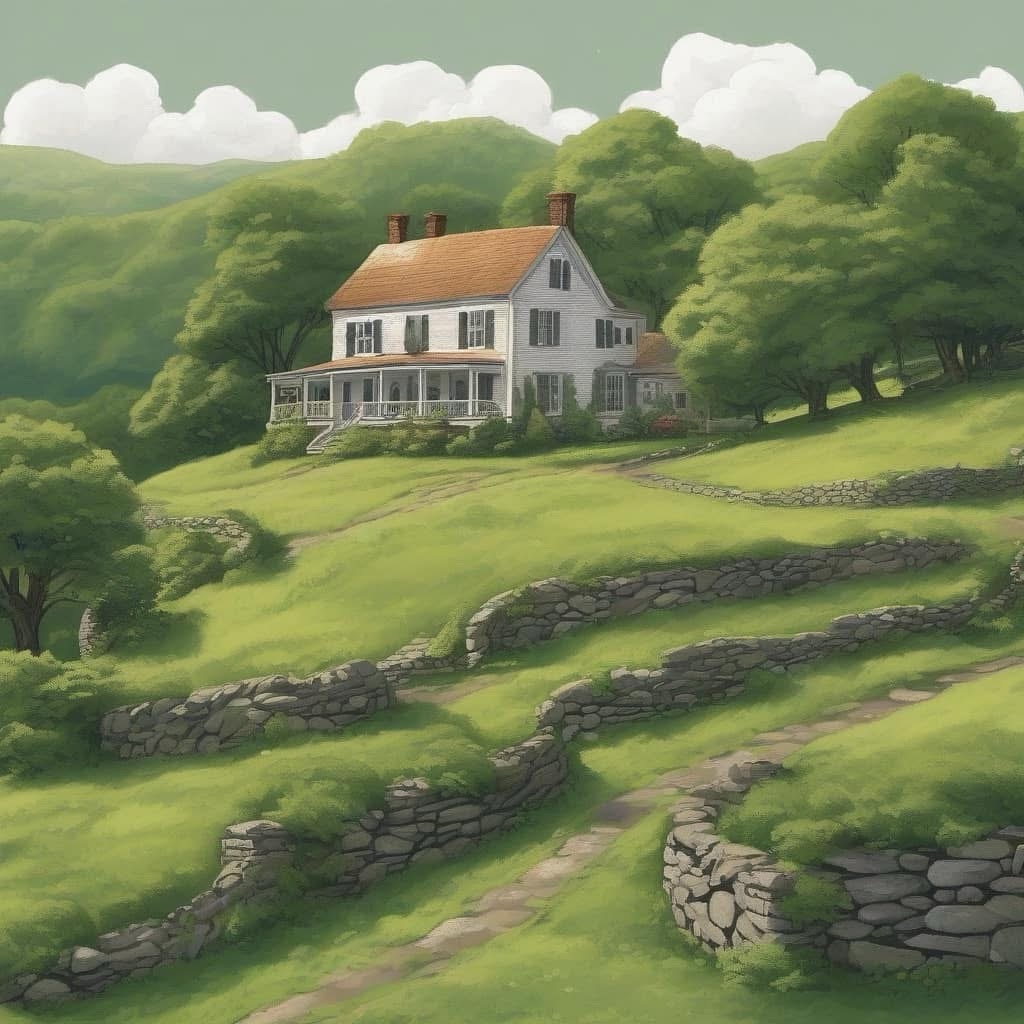
When we arrived, the farmhouse emerged from the foliage like a forgotten dream. The new owners had cradled its timeworn bones, preserving its essence. The stone walls, adorned with moss and lichen, bore the scars of countless seasons. Wooden fences leaned, their stories etched into the grain. It was as if the very earth conspired to keep the farmhouse rooted in its history. Inside, the air hummed with anticipation. The restoration was a symphony of craftsmanship. A dance between old and new. The creaking floorboards whispered secrets, and the hearth crackled with warmth. We traced our fingers along the polished banister, feeling the pulse of forgotten lives. The dining room, with its original porch now enclosed in glass, framed a tableau of nature, a living canvas where shadows danced as the sun dipped below the horizon. As we settled around the table, the forest beyond the glass thickened with twilight. The sun, a golden coin, hung low in the western sky, casting elongated shadows upon the porch.
And then, movement. A flicker at the periphery of my vision. I turned, expecting to find a trick of the fading light, but there he was: a man, his face pressed against the windowpane. My heart stuttered. His eyes met mine, and in that instant, I glimpsed eternity. His features were etched with longing, a spectral hunger that transcended time. I tore my gaze away, searching for reassurance among our guests. But they were engrossed in laughter and conversation, oblivious to the silent visitor.
Again, the man appeared, his gaze unyielding. Panic clawed at my throat. Why did no one else see him? Was he a phantom conjured by the house itself? I tried to focus on the meal, on the clinking of silverware and the warmth of companionship, but his presence lingered. An ache in my chest. Finally, one of our guests stood, her eyes narrowing. “What’s out there?” she asked, her voice slicing through the mirth. My wife glanced at me, her eyes questioning. I rose, my legs unsteady, and faced them all. “There’s a man,” I confessed, my voice trembling. “A man on the porch, watching us.”
My wife rolled her eyes, dismissing my words as the product of an overactive imagination. But as I led them to the window, I knew I wasn’t alone in this spectral dance. The man remained, his eyes locked on mine, bridging the chasm between centuries. And in that moment, I understood: the farmhouse held more than memories; it held echoes of souls who refused to fade away. So, we stood there living and dead, intertwined, our breath fogging the glass, our gazes unyielding. And as the night deepened, I wondered if the man sought solace or warning. Perhaps he was a guardian, a sentinel of forgotten love, urging us to honor the past even as we carved our own stories into the ancient wood. And so, we dined. A communion of the living and the lingering, Our laughter mingling with the rustle of leaves, our eyes straining to glimpse the otherworldly figure beyond the glass. For that night, the farmhouse cradled us all, stitching together the threads of time until we were no longer strangers but kin, bound by a shared location.
The homeowners turned on the porch light, casting a warm glow across the wooden boards. I stood there, my breath visible in the chilly night air, staring at the empty space beyond the glass. Nothing. The porch door was locked and latched on the inside, and the windows were firmly closed and locked in place. Yet, I knew what I had seen; a shadowy figure, fleeting and ephemeral, standing just beyond the threshold.
I turned to face the others, my voice trembling as I recounted my encounter. “There was a man,” I said, my words barely audible. “He was there, on the porch. But now… nothing.” The homeowners exchanged glances, their expressions a mix of curiosity and concern. They had invited me over for dinner, a cozy gathering of friends in their historic home. The atmosphere had been jovial, the wine flowing freely, until I had mentioned the mysterious visitor. Now, the air hung heavy with uncertainty.
The homeowner fetched a pad and pen, their movements deliberate. “Describe him,” they instructed, their voice calm despite the tension in the room. Everyone leaned in, eyes darting toward the now brightly lit porch. But there was no sign of the man—only the flickering light casting elongated shadows on the floor. I hesitated, struggling to find the right words. The man had been indistinct, like a half-remembered dream. His features blurred, yet his presence had been undeniable. “Tall,” I began, “with eyes that held secrets. His coat, old-fashioned, as if from another era.” As I spoke, I felt the weight of their scrutiny. Why had this apparition chosen me? Why had it materialized on that moonlit night, only to vanish without a trace? The following day, I called our friends to thank them for their hospitality and to apologize for the unsettling turn of events. They assured me it was no trouble, but I sensed their unease. Nothing more was mentioned, yet the memory lingered, a puzzle piece out of place. Then, thirty days later, the phone rang. It was the homeowner, their voices frantic. “Remember the description you gave?” they asked. “The man on the porch?” I nodded, though they couldn’t see me. “Yes.” “He came,” they said. “The man from the past. The great, great, great grandson of the original owner. He brought a painting, a family portrait.” I listened, my heart racing. The painting had been created on that very porch, the family standing proudly together. And the man who had appeared in the windows—the one I had glimpsed that fateful night—was none other than the original owner himself.
Relief washed over me. I hadn’t imagined it. But alongside relief came a question: Why me? Why had I been the witness to this spectral reunion? A few days later, a gift arrived in the mail: a 90-minute phone call with a Psychic from New Mexico. I scoffed at first, dismissing it as superstition. Yet, curiosity got the better of me, and I dialed the number. “Marie,” she introduced herself. Her voice held a soothing cadence, like wind chimes on a gentle breeze. “ She said that she wanted to tell me things about my past. She told me about the preemie twins that I worked with, the dying woman’s hands that I held, the nights in the ICU caring for my mother. Marie, her empathy palpable. And then she said something that made my breath catch: “You’re a bridge, my dear. Between realms.” Tears welled in my eyes. Marie had pieced together fragments of my life, woven them into a tapestry of purpose. She spoke of my prayers that I said during an exorcism when I was a senior Deacon, my touch easing suffering, my presence a conduit for healing. With tears running down my face, I realized that Marie had made me a believer—not in ghosts or spirits, but in my own extraordinary role. I was a keeper of stories, a witness to the unseen. And as I stood on that enchanted porch, I vowed to embrace my gift—to bridge the gap between the living and the departed, guided by the light of understanding and compassion.

 Stories Past Present Future