The emergency department never sleeps. It hums. It screams. It pulses with urgency, fluorescent lights buzz like hornets, monitors beep in dissonant rhythms, and every hallway holds the echo of some heartbreak, some miracle, or both. The air smells of antiseptic, coffee gone cold, and something deeper: burnout masked in perfume and professionalism. And then… there’s Quinn. Every week, like clockwork, or perhaps like grace, he arrives.
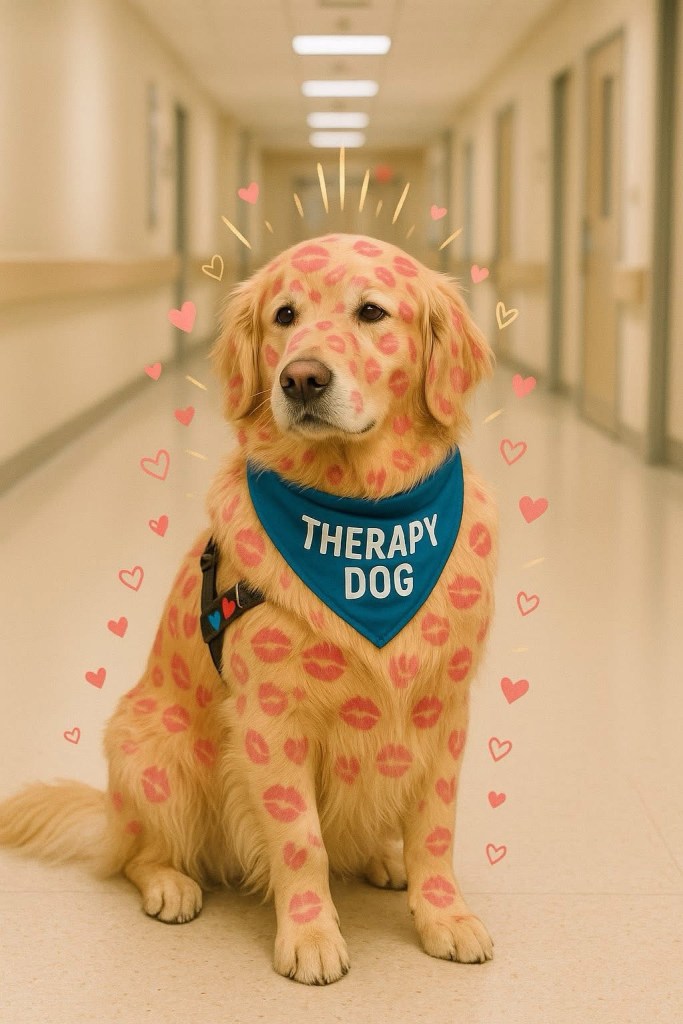
A Golden Retriever with a coat the color of soft candlelight, eyes like warm earth, and a heart that beats not just for those in pain, but with them. He doesn’t just walk through the ER doors, he glides, as if carried by an unseen current of healing. His blue bandanna reads “THERAPY DOG,” but to the staff, he is something far more. Sanctuary in motion. Hope on four legs.
The nurses spot him first, shoulders sagging from the weight of double shifts, sleepless nights, and the quiet grief that accumulates like dust in their hearts. As soon as Quinn enters, something shifts. The sterile air seems softer. The overhead lights feel less harsh. A nurse named Lena, who hasn’t exhaled fully in twelve hours, drops to her knees. Quinn presses his head into her chest, and she crumbles, not from weakness, but from the permission to finally let go. No words are needed. Quinn is fluent in sorrow, and even more fluent in solace.
The ICU is colder, quieter, heavy with machines that mimic life. Quinn moves through it like a breeze through a cathedral. Doctors with trembling hands pause to rest their palms in his fur. Respiratory therapists, who have just witnessed the final breath of someone’s father, lean down to let Quinn’s gaze meet theirs. His eyes say what no chart ever could: You are not alone.
His fur, golden and dense, seems to soak up the stress, the unspoken pain, the silent prayers, the pressure no one else can see. He carries it all without complaint, without fatigue, with a grace that borders on divine.
It is unconditional love in its purest form unwavering, unjudging, unshakable. To Quinn, it doesn’t matter how stained their scrubs are or how hollow their laughter sounds. He looks at them as if they are made of light. And somehow, they begin to believe it too.
One nurse, eyes glassy after losing a patient she’d grown attached to, buried her face in Quinn’s neck and whispered through tears, “You’re the only one who knows how much this hurts.” Quinn didn’t move. He simply leaned in, deeper. That’s all he ever does, stays, holds space, loves with his entire being.
And if love were visible, if every touch of gratitude, every burst of affection, every tear he had comforted could leave a mark, Quinn would be covered in kisses from head to tail. His golden fur would bloom in lipstick reds and cherry pinks, soft petals of thanks from every nurse and doctor whose spirit he had lifted.
He would walk the halls like a living bouquet of love. Even the toughest trauma surgeons, the ones who wear sarcasm like armor, soften in his presence. In the breakroom, one of them once said, half joking and half-breaking, “If I could bottle Quinn’s spirit, I’d put it in every crash cart.”
By the time he leaves, the entire hospital breathes easier. The tightness in the air eases. The color returns to tired faces. A single therapy dog can’t erase the tragedies, but Quinn doesn’t try to erase.
He arrives to absorb. To understand. To remind. And as he exits, tail swaying like a banner of calm, blue bandanna fluttering in the breeze, someone always whispers through the doors:
“He loves us like no one else can.”
Because love like his doesn’t just walk beside you.
It anchors you.

 Stories Past Present Future