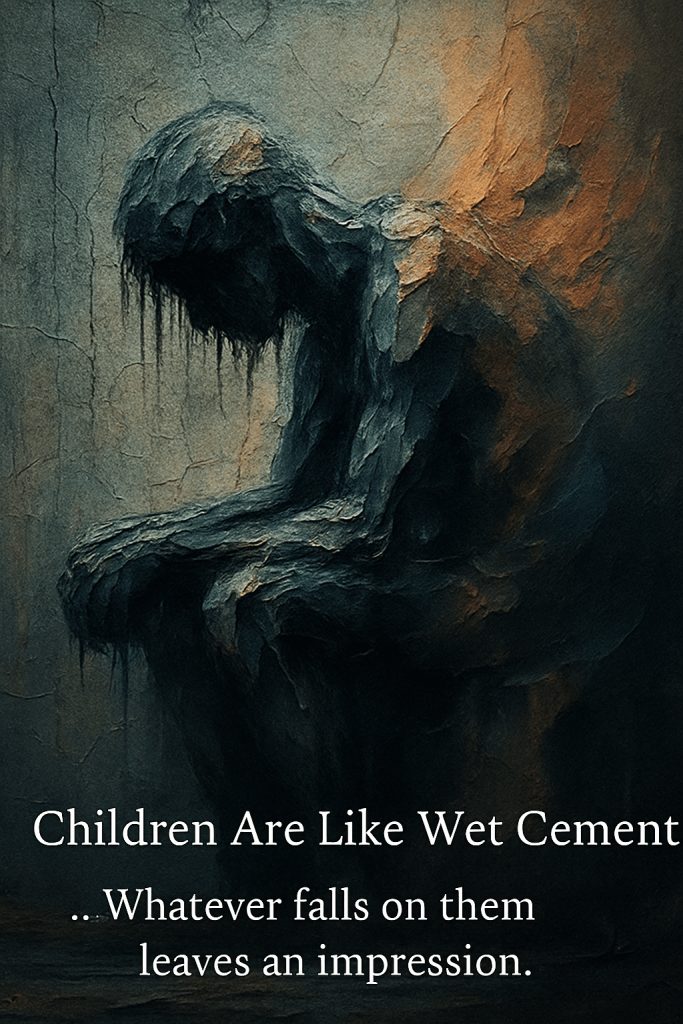
The room reeked of mildew and yesterday’s sorrow. A single bare bulb dangled overhead, its light flickering like a nervous pulse. In the corner, he sat, knees drawn to his chest, forehead resting on bruised fists, his small body carved into a silhouette of grief. The air around him was thick, still, and humid with the ache of things unspoken. He wasn’t stone. Not yet.
He was soft. Malleable. The kind of softness found in rain-soaked clay or newly poured cement, warm to the touch, trembling at the surface, waiting for the world to press itself into him. And the world did. It fell in shards.
The first imprint came with the sharp slam of a cupboard door and the shatter of a glass that followed. Not at him, but near him close enough that his skin remembered the vibration long after the sound died. The second was colder: a quiet neglect, the kind that seeps into the marrow. No bedtime stories. No kisses placed gently on sleeping foreheads. Just silence, stretched so tight it hummed like a live wire. He began to learn the language of survival.
The scent of whiskey signaled danger. The thunder of boots on hardwood meant hide. A mother’s gaze that slid past him like fog meant vanish. Even in a room full of people, he became invisible, transparent like steam rising from a cracked teacup. And still, the impressions came.
A belt once curled on the floor like a snake. The harsh scrape of words like, “What’s wrong with you?” branded his ears. Each insult landed like gravel tossed into wet concrete, sinking fast, permanent. The walls of his world offered no comfort, just peeling paint and shadows that moved when no one else did.
One night, in the darkness between midnight and regret, he pressed his hands over his ears. But he couldn’t unhear the past. Couldn’t unsmell the fear. Couldn’t scrub away the shame clinging to his skin like soot.
His body aged, but the cement never truly set evenly. It cracked in places where it dried too fast. It sagged where no support was given. The boy became a man, but deep inside, the child still crouched, frozen in that same posture, still listening for the door, still bracing for what might fall next. Yet, not all was ruin.
Somewhere in the wreckage, a hand once reached out. It belonged to a teacher who saw not a troublemaker, but a boy who had learned that speaking up meant punishment. She knelt beside him once during lunch, her hand warm against his hunched back, and whispered,
“You don’t have to carry all of it alone.” And for a moment, the cement softened again. Just enough.
He never forgot that. That kindness was a thumbprint, too. Gentle, but deep. It stayed, not as a wound, but a root. Because the truth is this: everything leaves a mark.
Every word. Every touch. Every absence. Some crush. Some carve. Some redeem. So be mindful of your hands, your words, your eyes. You are always shaping someone. And children… Children are like wet cement.

 Stories Past Present Future