What Two Nursing Home Residents Taught Me About Being Seen
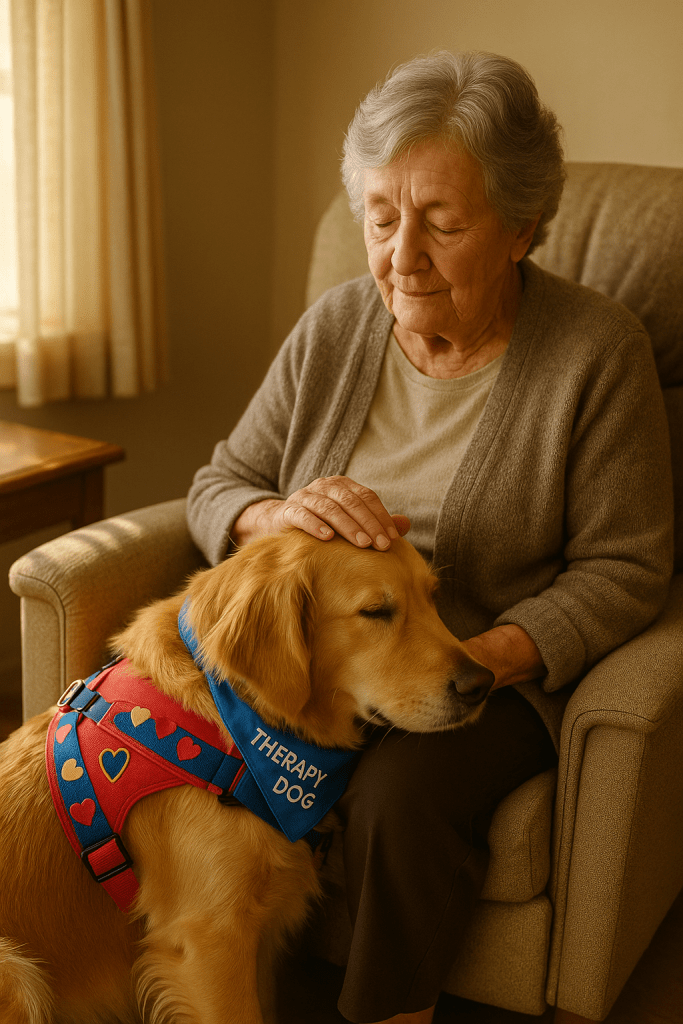
Every week, I walk the quiet, time-softened halls of a local nursing home with my golden retriever therapy dog, Quinn. His coat glows golden in the morning light, his tail sways like a gentle promise, and his red harness, decorated with blue, yellow, and white hearts, catches the eyes and the hearts of those who wait for us.
Quinn doesn’t just visit. He listens.
He reminds people they are still here. And so do I. We don’t come to fix anything. We come to sit beside stories that the world has stopped asking to hear.
The Man with the Carnations
One gentleman shared his story with me as Quinn rested his head gently against his knee. “It was just after Valentine’s Day,” he said softly. “I wanted to surprise her with pink carnations. Always her favorite. She pressed one into her Bible every year.”
He went to a big-box store with that intention, list in hand, hope in heart. “But everything was so bright… so loud,” he said. “I asked a boy stocking shelves, but he just pointed over his shoulder. Didn’t even look at me.”
He wandered the aisles in confusion, passing displays of snacks, detergent, noise. It overwhelmed him. He started to panic. The store had become unfamiliar terrain.
Then, a moment of grace. A young girl noticed him. “She didn’t ask what I needed,” he said, his voice cracking. “She just smiled and said, ‘Let’s find them together.’” He found the carnations. But when he finally made it home, he had gotten lost twice, left the oven on, and forgot why he had even gone.
“That was the night my daughter came over,” he said, staring at the floor. “The carnations were still in the bag.” Three weeks later, he was here.
The Woman in the Heat.
A few days later, another resident shared her story while Quinn gently pressed his body beside her recliner.
“I fell outside a café last summer,” she said, brushing a hand over her wrapped leg. “Tore my shin up pretty bad.” She’d gone out for coffee. She was proud of still doing things herself. But the heat was intense, and after her fall, the walk to her car was slow and painful. “I passed three tables full of people. Not one of them looked up. Not one asked.” She reached her car. The heat inside was unbearable.
“I sat there bleeding, too dizzy to think. Couldn’t figure out how to work the air conditioning. I thought maybe… maybe that was it.”
Eventually, a young man approached. He didn’t ask questions. Just turned on the air and stayed with her. Later that night, she developed a fever. Her leg was infected. “That was the start,” she said. “Hospital. Rehab. Then here.”
She stroked Quinn’s ears. “They said I couldn’t live alone anymore. But I just didn’t want to be invisible anymore.” What They Shared, and What They Still Need
These stories weren’t told for sympathy. They were given as gifts, offered like folded letters no one had read in years. They are reminders that aging isn’t fading away. It’s becoming quieter in a world that forgot how to listen.
And Quinn… Quinn listens with his whole being. He doesn’t rush. He doesn’t judge. He simply stays. He is not just a therapy dog. He is a bridge between then and now. A warm light in a world that sometimes forgets to slow down.
So the next time you see an older person. confused at a grocery shelf, hesitating at a sidewalk, sitting quietly by themselves, don’t just walk past.
Notice them. Speak, sit…
One day it will be us.

 Stories Past Present Future