The Scent of Stillness: In the dim morning light of a hospital corridor, the air carries a thousand unspoken things. Bleach. Warmed plastic. The ghost of coffee from the nurses’ station. But to Quinn, the golden retriever in a black harness with tiny hearts embroidered over the surface, there is more. There is the scent of sorrow clinging to the folds of a nurse’s scrubs. There is the sharp metallic spike of fear trailing behind a man waiting on biopsy results. And there is something else, something deep and invisible, a scent the human world rarely notices: Stress. Raw, unfiltered, chemical sorrow.
To Quinn, it is unmistakable. It dances off the skin, hidden in beads of sweat and the exhale of shallow breath. It rises like steam from the anxious mother pacing the pediatric unit and clings like fog to the shoulders of a hospice patient who knows the end is near.
But Quinn does not flinch. Instead, he slows his pace near the oncology waiting room. I remain silent. I know that when Quinn lowers his head slightly and breathes deeper, he’s found someone.
There, seated near the window, is a young man in his twenties. He’s staring at a phone he hasn’t touched in ten minutes. His foot taps restlessly, but his face is still. Too still. His hoodie is zipped to his neck though it’s warm inside, and the air around him smells… different. Not fear, but pressure. Panic behind a mask. Cortisol rising like heat through the skin.
Quinn walks directly to him and plants himself gently at the man’s feet. No prompting. No command.
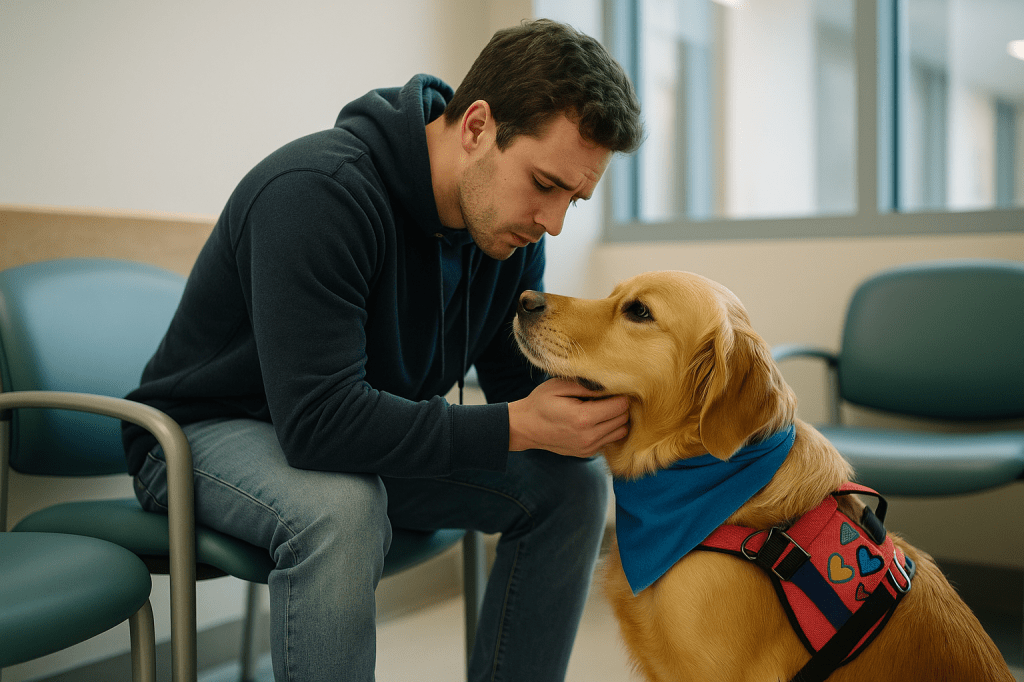
The man looks down. His eyes are damp, but his hands are fists. “ Hey, buddy,” he whispers, almost startled by his own voice. Quinn doesn’t lick, doesn’t paw. He just is. Present. Anchored. Breathing with him. And slowly, so slowly, the fists open.
The young man lowers his hand. Quinn lifts his head just enough to rest his chin in the palm. The man’s shoulders release a fraction. He blinks hard. “I didn’t even know I needed this,” he mutters. But Quinn knew. He smelled it in the air before it became a sob. He read the story of the man’s stress in scent the way we read words on a page.
The Invisible Language
This is not magic. This is biology softened by love. Recent research has shown what handlers and patients have always known in their bones: dogs like Quinn don’t just observe us, they inhale us. They track the rise of cortisol in our sweat and breath like the wind shifting through trees. They know when we’re anxious before we do. Their comfort isn’t accidental, it’s intentional, biochemical empathy.
In memory care units, therapy dogs often gravitate toward those on the edge of agitation. In psych wards, they curl up beside someone long before the panic attack has a name. They preempt despair by scent alone.
This is why a therapy dog doesn’t need to be told who to visit first. They choose. They listen, not with their ears, but with their hearts and their noses.
The Sacred Work
At the end of the visit, Quinn walks back through the hospital with his tail swaying gently, the scent of relief still lingering behind him. He has inhaled suffering and exhaled solace. For those who say dogs can’t speak, perhaps it’s because they’re too busy listening in ways we cannot hear. Or rather, smelling in ways we cannot fathom.
Image is AI generated as I do not have the patient’s permission to use his photo-

 Stories Past Present Future