It’s always the caregivers who find him first. Before we ever reach a patient’s bedside, we’re met by nurses with weary eyes and physicians with invisible burdens tucked beneath their white coats. But our first greeting doesn’t come inside the hospital walls, nor it begins in the parking lot.
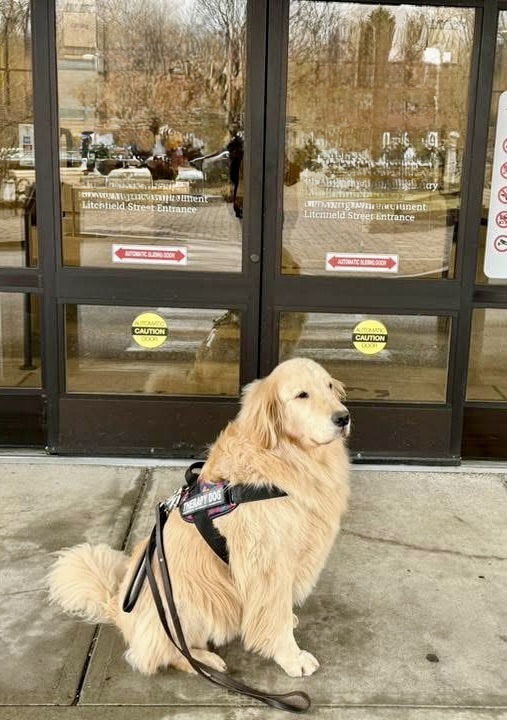
Every Sunday afternoon, Quinn and I step from our car, the sun warm on his golden coat, the leash loose in my hand. Even before the automatic doors hiss open, visitors approaching the hospital seem to drift toward us. Some offer quiet smiles. Others pause completely, their hands reaching for the comfort only a dog like Quinn can provide. “Can I pet him before I go in?”
The question is always gentle, sometimes tearful. They’re family members, friends, or loved ones about to step into a room filled with uncertainty. And in those moments, on concrete beneath the open sky, Quinn offers sanctuary. Once inside, the lobby guards call his name like a returning hero. “Quinn’s here,” one says, standing from the desk, hand already extended.
“He’s just what we needed today.”
The hospital air changes from there. As we move deeper inside, the energy tightens, like invisible strings being pulled from every direction. Our path leads to the Emergency Department, where the atmosphere grows dense, almost tactile. The air smells of antiseptic and adrenaline. Gurneys line the hallways, some holding patients, others waiting, like exclamation marks on pause. Monitors beep in disjointed rhythms. Overhead, the loudspeakers crackle:
“Code Blue—Room 7. Rapid Response—Bay 3.” It’s here, in the thrum of chaos, that Quinn steps into his true purpose.
We enter the nurses’ station, a space that feels more like an air traffic control tower than a sanctuary. Screens flicker with vital signs. Telemetry data scrolls like stock tickers. Nurses cluster with eyes scanning not just for changes, but for signs, subtle dips, erratic pulses, red flags in motion. The weight of life and death decisions presses against every heartbeat in that room. And then Quinn appears, quiet, calm, present. He doesn’t bark or beg for attention. He simply walks into the eye of the storm and becomes the stillness within it.
A nurse stiffens as she sees him, then softens. She kneels, burying her face into the fur of his neck, shoulders heaving with breath she’s held too long. A paramedic, fresh from a trauma intake, runs his hand down Quinn’s back and exhales deeply, as if shedding an unseen layer of stress.
Ohio State’s Buckeye Paws program studied this very thing. Their findings showed that in just five minutes, healthcare workers, doctors, nurses, respiratory therapists, reported nearly double the improvement in mood. Burnout lessened. Emotional exhaustion lifted. Even with monitors still beeping and codes still echoing, the presence of a therapy dog offered an island of peace. And I’ve seen it, not in data, but in eyes. In trembling hands. In sudden laughter.
Once, in that same ER corridor, a young nurse knelt beside Quinn and whispered, “Yesterday I went home and cried. Today I saw him… and I could breathe again.”
Sometimes, patients wait an extra minute while we tend to the caregivers. But they always understand. They nod. They smile. They know that those tending to their wounds need healing too.
And Quinn? He never tires. He leans in. He listens with his body. He leaves pieces of peace everywhere we go.
Author’s Note:
In hospitals across the country. And in research studies like those at Ohio State, therapy dogs are proving what many of us have long known: sometimes the most powerful medicine has four paws, a wagging tail, and an uncanny ability to know exactly who needs them most

 Stories Past Present Future