They say dogs don’t understand death. But maybe it’s not death they misunderstand, maybe it’s absence they understand far too well. More than we ever could. When a soul slips from its body like breath on a mirror, what remains is invisible to us, but not to them. Dogs don’t see ghosts. They feel the echo.
Medical workers who’ve spent their lives beside the dying who’ve stood in the sacred stillness of final moments will quietly tell you something astonishing: When someone dies at home and their dog is present, something else happens. It begins almost immediately. Not with howling. Not with barking. But with movement.
In the hours after the last heartbeat, the dog begins to pace, slowly, deliberately, from room to room, tracing a path known only to them. Not random. Never random. They follow the invisible thread of your presence from the chair still warm with memory, to the bedside where your slippers rest, to the porch where you once watched the wind stir the trees. Their paws don’t just touch the floor. They stir the silence. They’re not lost. They’re tracking you, or the pieces of you that haven’t fully let go.
By the second day, the pacing softens. Grief takes on a different shape. Now, they seek your scent, a sweatshirt on the couch, a pillow indented by your dreams. They nuzzle into the fabric with reverence, pressing their face deep, as if scent alone could summon you home. And they can smell you. To them, you are still there in the threads, in the air, in the skin cells you shed without thought. They’re holding on to the smallest traces of you. Because they’re all that’s left.
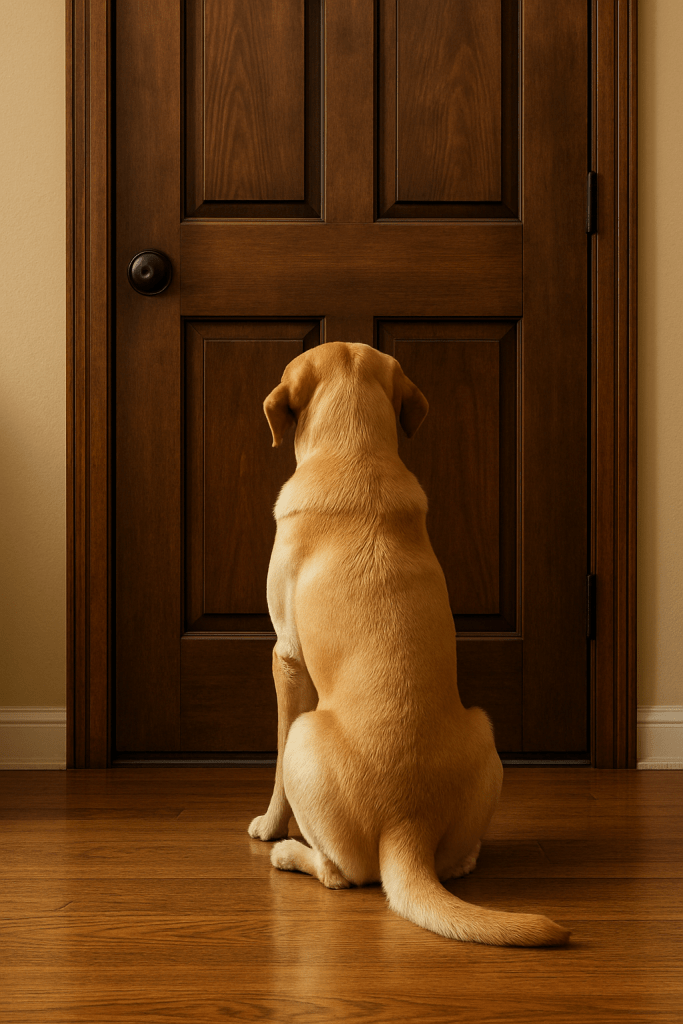
Then comes what hospice nurses quietly call, “the door vigil.” Your dog plants themselves by the door you always came home through, the back door with the sticky handle, the front door with the creaky hinge. And they wait. Not for minutes, for hours. Sometimes through the night. They don’t move. They don’t eat. Unless your chair is pulled close, or the food is placed where you once sat. This is not confusion. This is not denial. This is devotion incarnate.
Some families, seeking to understand, set up cameras during this time. What they witness is haunting and holy: The dog whimpers. Not in any tone they’ve made before, but in one reserved only for the deepest grief. Animal behaviorists call it a rare vocalization. Others call it what it feels like, a call between worlds. A sound meant not for the living… but for you. And then. gently, almost invisibly, something shifts.
On the third day, or the fourth, or the seventh… they rise. They walk toward your spouse, still clutching your wedding band. Toward your child, crying silently beneath the blanket you shared. Toward your parent, too still to speak. And they lie down. Sometimes at their feet.
Sometimes curled against a weeping heart. Sometimes with their head resting where your hand used to fall. As if to say: “I see them in you. I will stay.” Maybe this is why ancient cultures believed dogs could walk between worlds. Because they never let love end where life does.
Because their bond is stitched not in time, but in soul. Dogs don’t mourn like we do. They embody the loss. And then… they carry the love forward. They become the bridge between what was… and what still remains. Maybe. just maybe, they’re not waiting for us to come back through the door. Maybe they’re waiting for the day when we’ll walk each other home.

 Stories Past Present Future